Platforms
WeChat advertising: every ad format and what they actually cost

Six placements, three pricing models, and a minimum spend that trips up most international brands. A practical guide to WeChat’s ad system.
Why WeChat ads work differently
WeChat has over 1.4 billion monthly active users who spend an average of 80 minutes per day inside the app. But unlike Douyin or RedNote, where ads compete for attention in a fast-scrolling discovery feed, WeChat ads land inside a closed, trust-based environment. Your Moments ad sits between posts from the user’s friends and family. Your Official Account ad appears inside an article they chose to read.
That makes WeChat advertising more precise than most platforms. It also means the bar for creative quality is higher. If your ad does not feel like it belongs in someone’s personal feed, it will not perform.
WeChat is not the platform for viral reach. It is the platform for reaching the right people, in the right context, with content that belongs there.
All WeChat advertising runs through the Tencent Ads platform. You need a verified WeChat Official Account to run any ads. No account, no campaigns. And verification requires a Chinese business entity or an authorized local representative.
The six ad placements
WeChat offers six advertising positions. They are spread across the ecosystem and each one does something slightly different.
| Placement | Where it appears | Best for |
|---|---|---|
| Moments Ads | In the user’s personal feed, styled like a friend’s post | Brand awareness, product launches, major campaigns |
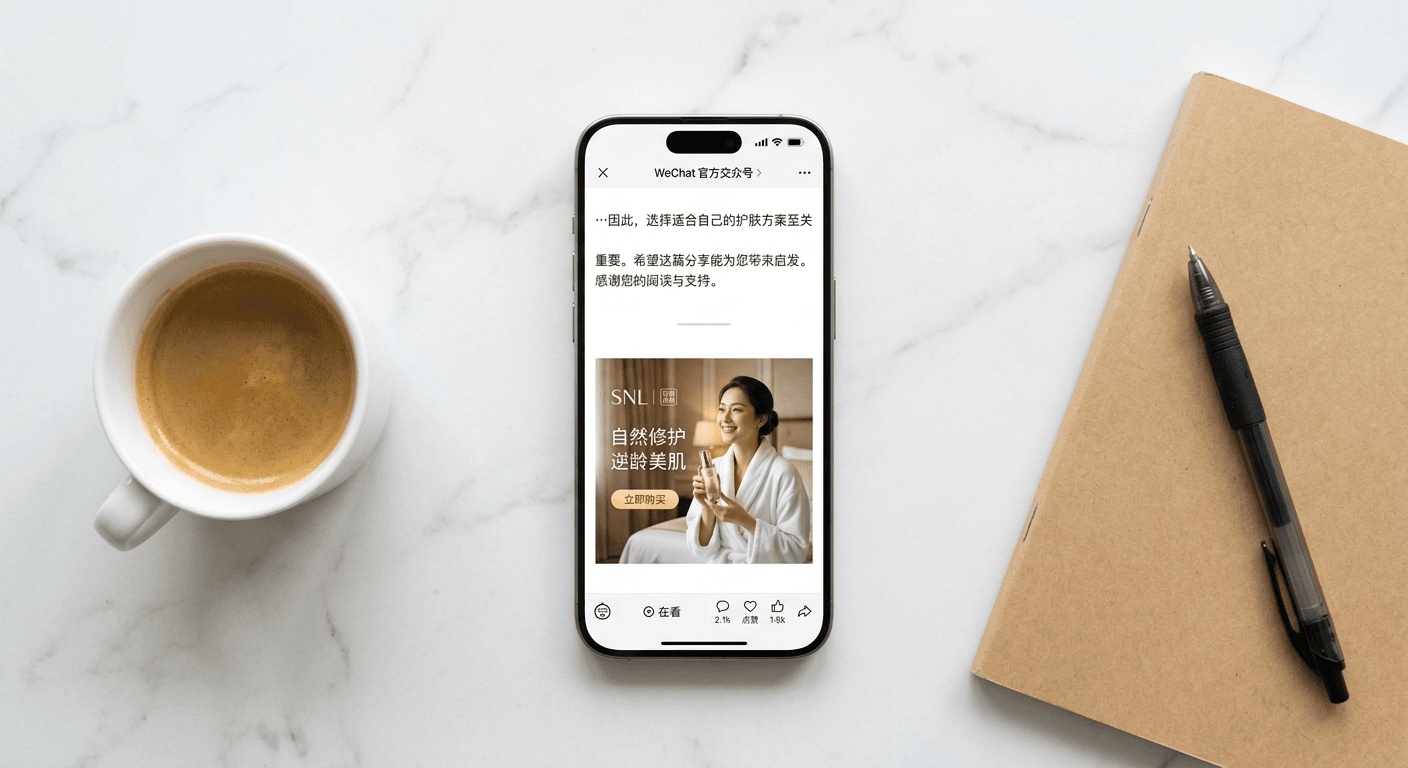
| Official Account Ads | Article bottom, mid-article, video pre-roll | Content-led conversion, follower growth |
| Mini Program Ads | Banners, interstitials, rewarded video inside Mini Programs | E-commerce, app installs, gaming |
| Channels Ads | In-feed video in WeChat Channels | Video reach, livestream promotion, product discovery |
| Search Ads | Keyword results in WeChat Search | Intent-based targeting, brand protection |
| Top Stories Ads | In the curated content feed | Article discovery, content promotion |
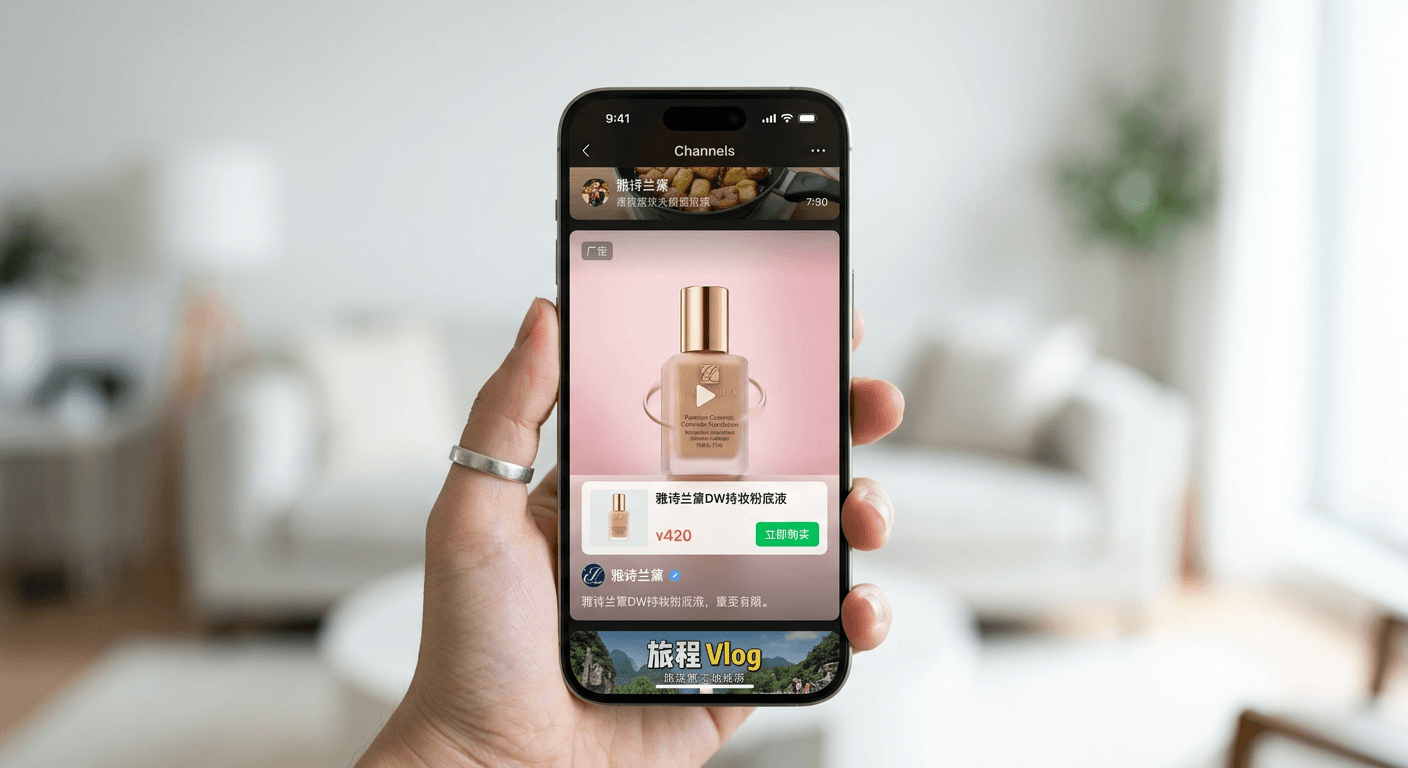
Channels is the one to watch. Daily active users on WeChat Channels exceeded 800 million in 2025 according to Tencent’s own reporting, and Channels ad revenue grew 60% year-over-year in 2024. It is still relatively underpriced compared to Moments, which makes it a strong option for brands looking for video reach without Moments-level budgets.
How pricing works
WeChat uses three pricing models. The right one depends mostly on how much you want to spend and what you are trying to get out of it.
CPM: pay per 1,000 impressions
The most common model for Moments ads and brand campaigns. Rates vary by city tier and by how you buy.
| City tier | Scheduled CPM | Bidding CPM range |
|---|---|---|
| Core (Beijing, Shanghai) | Around 150 yuan per thousand | 100-300 yuan per thousand |
| Key (Guangzhou, Shenzhen, Chengdu, Hangzhou and 18 others) | Around 100 yuan per thousand | 60-200 yuan per thousand |
| Standard (all other cities) | Around 50 yuan per thousand | 30-200 yuan per thousand |
Video ads cost roughly 30-50% more than image ads at the same impression level. For context, Douyin’s paid traffic CPM through Ocean Engine runs 30-60 yuan, but that is for amplification of existing content, not native feed placement. WeChat Moments CPM is higher because you are buying placement inside a personal social feed with much higher trust signals.
Source: Zhihu, industry benchmarks
CPC: pay per click
Common for Official Account article ads and Mini Program banners. The floor is low: article-bottom ads start at around 0.5 yuan per click. But Moments CPC is a different story, running 2-20 yuan depending on how tight your targeting is and how many other brands are bidding for the same audience. For comparison, Baidu search ads average 2-15 yuan per click. The difference is that WeChat clicks come from users in a social context, not a search context. That changes how you should think about what a click is worth.
Source: Yiban, Zhihu
oCPM: smart bidding
WeChat’s AI-powered model. You set a target conversion cost and the system adjusts your bid in real time to reach users most likely to take action. In 2025, Tencent added new AI bidding tools that cut costs by an estimated 10-15% compared to manual bidding. Once you have enough conversion data flowing in, most advertisers on WeChat gradually shift to oCPM. It takes a few weeks to build up the data the algorithm needs, but after that it tends to outperform manual bidding consistently.
Source: Yiban
Minimum spend: what you actually need to start
This is where a lot of brands get tripped up. The minimums depend entirely on your buying method.
| Buying method | Minimum |
|---|---|
| Scheduled buy | 50,000 yuan per campaign (around $7,000) |
| Bidding buy | 1,000 yuan top-up, 1,000 yuan per day budget |
| Local promotion | 300 yuan per day (around $42) |
The 50,000 yuan scheduled buy is designed for larger brand pushes. You lock in guaranteed impressions 1-28 days in advance. Think product launches, seasonal campaigns, or major events. It is a “pay now, guarantee eyeballs” model.
Source: Niaoge Biji, Digitaling
For international brands testing the waters, the bidding model at 1,000 yuan per day is the most practical starting point. You control daily spend, adjust targeting in real time, and only pay for impressions or clicks that actually happen.
Local promotion at 300 yuan per day is the cheapest entry point but only works for geo-targeted campaigns within 3-5 km of a physical location. Good for restaurants, retail stores, or event venues. Not useful for national brand campaigns.
Practical things nobody tells you
Creative review is strict and slow. WeChat rejects ads with exaggerated claims, unverified statistics, health promises without government certification, or anything that encourages sharing or forwarding. Review takes 1-2 business days. Build that into your campaign timeline or you will miss your launch window.
Moments ads compete with real people. This is not a banner on a website. Your ad shows up between photos of someone’s kid and their coworker’s vacation. If it does not look and feel like something a person would actually post, people will scroll past in half a second.
One creative swap per campaign. WeChat allows you to update your Moments ad creative up to three times per month, but each change goes through review again. Plan your creative upfront.
Peak hours cost more. Bidding during evening prime time (7-9 PM) costs 20-40% more than off-peak. If your budget is tight, test daytime slots first.
Source: Aiyong Tech
The bottom line
WeChat advertising is not cheap. But for brands that need to reach Chinese consumers inside a trusted, closed ecosystem, nothing else comes close.
Moments works best for awareness. Official Account ads are better for content-led conversion. Channels gives you video reach at a lower price point than Moments. And Search captures people who are already looking for something specific. Start with bidding to test what is working, then scale into scheduled buys once you have the data.
The pricing is not cheap. But once you understand how the pieces fit together, it is not as complicated as it looks from the outside either.
Need help setting up WeCom for your brand in China?
Book a call